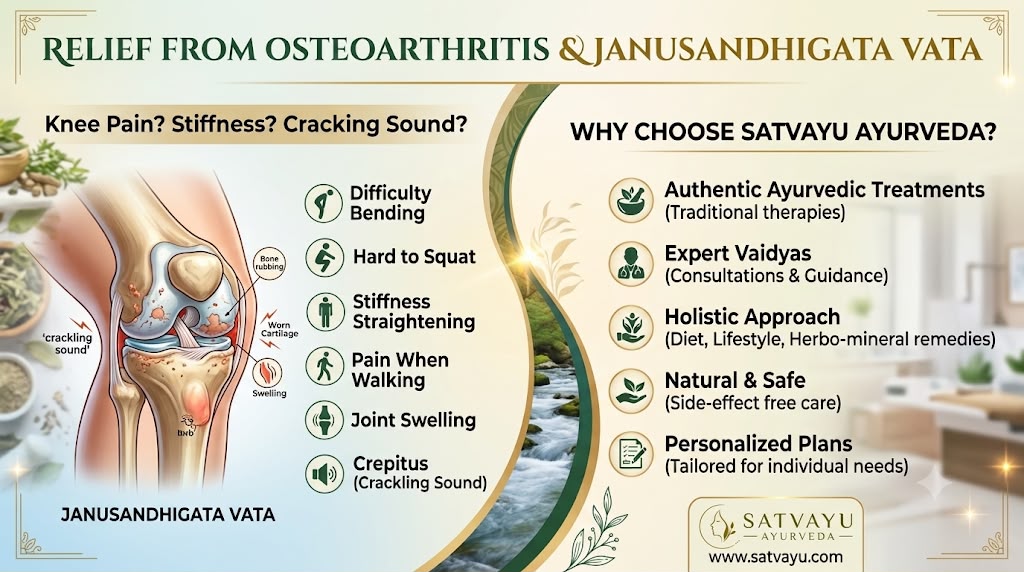
Does your knee hurt while climbing stairs, squatting, walking for a long time, or getting up from a chair?
Persistent knee joint pain is often dismissed as a normal part of ageing. But when pain, stiffness or restricted movement begins affecting your everyday life, your joints deserve more than temporary relief.
One of the most common causes of chronic knee pain is osteoarthritis (OA). In Ayurveda, a condition with significant clinical similarities is described as Sandhigata Vata, particularly when aggravated Vata becomes localized in a joint.
At Satvayu Ayurveda Clinic, we believe that effective joint care begins with understanding why the pain has developed—not simply where it hurts.
What Is Osteoarthritis?
Osteoarthritis of the knee is a chronic degenerative joint condition that commonly affects weight-bearing joints. It can result in pain, stiffness, reduced mobility and difficulty performing routine activities.
Common symptoms include:
Interestingly, several of these features have parallels in the classical description of Sandhigata Vata.
What Is Sandhigata Vata?
The name itself provides an insight:
Sandhi = joint
Gata = situated in
Vata = the Dosha responsible for movement and various physiological functions
When aggravated Vata becomes localized in a joint, Ayurveda describes the condition as Sandhigata Vata.
Acharya Charaka describes this condition with characteristic pain, swelling and discomfort associated with movement of the affected joint.
A classical description states:
सन्धिगतोऽनिलः शोफं करोति वातपूर्णदृतिस्पर्शं प्रसारणाकुञ्चनयोर्वेदनां च।
Prasāraṇākuñcanayor Vedanā — Pain During Movement
One of the most clinically relevant expressions in this description is:
प्रसारणाकुञ्चनयोर्वेदना — Prasāraṇākuñcanayor Vedanā
Here:
Prasāraṇa = extension or straightening
Akuñcana = flexion or bending
Vedanā = pain
In simple terms, it describes pain during flexion and extension of the joint.
Think of someone saying:
“My knee hurts when I bend it.”
“It pains when I straighten my leg.”
“Climbing stairs has become difficult.”
“I cannot squat like I used to.”
This classical description makes Janu Sandhigata Vata particularly relevant when discussing symptoms resembling knee osteoarthritis.
Sandhi Shoola, Swelling and the Familiar Cracking Sound
Ayurveda describes Sandhi Shoola—pain in the joint—as an important manifestation of Sandhigata Vata.
Classical descriptions also mention characteristic swelling and, in later texts, Atopa, commonly interpreted in this context as abnormal joint sounds or crepitus.
That familiar cracking, clicking or grinding sensation in the knee can therefore be an important clinical feature during assessment.
This is one reason Janu Sandhigata Vata is frequently correlated with osteoarthritis of the knee in Ayurvedic literature.
However, an important distinction must be made:
Sandhigata Vata and osteoarthritis should not simply be considered identical.
Osteoarthritis is a modern biomedical diagnosis, whereas Sandhigata Vata is an Ayurvedic disease concept understood through Dosha, Dhatu, Agni and Samprapti.
There may be significant clinical overlap, but Ayurveda approaches the individual through its own diagnostic framework.
Why Does Sandhigata Vata Develop?
Ayurveda gives particular importance to Vata in degenerative and age-associated changes.
With advancing age, Vata naturally tends to increase. Factors such as repetitive joint stress, excessive physical activity, previous injury, inadequate rest, sedentary habits, excess body weight and inappropriate diet and lifestyle may also influence joint health.
But there is no single explanation for every case of knee pain.
Two people may both have osteoarthritis, yet their Prakriti, Agni, lifestyle, body composition, pain pattern and Ayurvedic Samprapti may be completely different.
This is where individualized Ayurvedic care becomes important.
Ayurvedic Treatment for Osteoarthritis and Sandhigata Vata
There is no single best joint pain treatment that is suitable for everyone.
Ayurvedic management of Sandhigata Vata is individualized according to the person’s age, strength, Dosha involvement, stage of disease, pain pattern, stiffness, swelling, digestive status, lifestyle and associated conditions.
Depending on the clinical presentation, an Ayurvedic physician may consider therapies such as:
Therefore, the best Sandhigata Vata treatment is not necessarily the same for every patient.
The goal is to understand the underlying pattern and support pain relief, mobility and better joint function through a personalized approach.
When Should You Seek Treatment for Knee Pain?
Persistent knee pain should not simply be accepted as an unavoidable consequence of ageing.
Consider getting assessed if you experience:
If you are searching for the best joint pain treatment, it is important to first understand the cause of your pain rather than choosing a treatment based solely on the name of the condition.
Your Knee Pain Has a Story
A painful knee is not merely a joint that has “become old.”
It is influenced by age, movement, body weight, previous injury, lifestyle, tissue health and individual constitution.
The classical description of Sandhigata Vata, particularly Sandhi Shoola and Prasāraṇākuñcanayor Vedanā, offers a meaningful Ayurvedic perspective when we encounter symptoms resembling knee osteoarthritis.
At Satvayu Ayurveda Clinic, we believe the right question is not only:
“Where does it hurt?”
but also:
“Why has it become painful in you?”
Understanding that difference is the beginning of personalized care.
Looking for Ayurvedic Treatment for Knee Pain in Pune?
If persistent knee pain, Sandhi pain, stiffness or restricted movement is affecting your daily life, consult an Ayurvedic physician for an individualized assessment.
At Satvayu Ayurveda Clinic, we provide personalized Ayurvedic care for osteoarthritis, Sandhigata Vata, knee joint pain and chronic joint disorders in Pune and Bavdhan.
If you are looking for the best joint pain treatment or best Sandhigata Vata treatment in Pune, begin with a proper assessment of your individual condition.
Because healthier movement begins with understanding the joint—not simply suppressing its pain.